Tuesday, 20 December 2016

One year later... an update

I really should have posted something here before now. I wouldn't wish my loyal followers (all two of them) to think I've been inactive, but I keep telling myself "I'll write something about that when it's finished." The problem is that nothing on St Petrock is finished. Instead, I've been gradually 'working up' the detail on the whole layout, concentrating my effort in different places with little appeal to logic.  The advantage of this approach, I tell myself, is that I don't risk getting bored – one day buildings, another day rolling stock, and another scenery....

So here's an update on a year at St Petrock.

Station Buildings Area


Not much has changed here, the most important thing being that all track is now ballasted, using Woodlands Scenics fine brown ballast. I mixed in some grey chippings to make it look like the ballast that used to come from Meldon Quarry, but may have overdone it a bit.  Oh well... too late to change it now.

Goods Yard
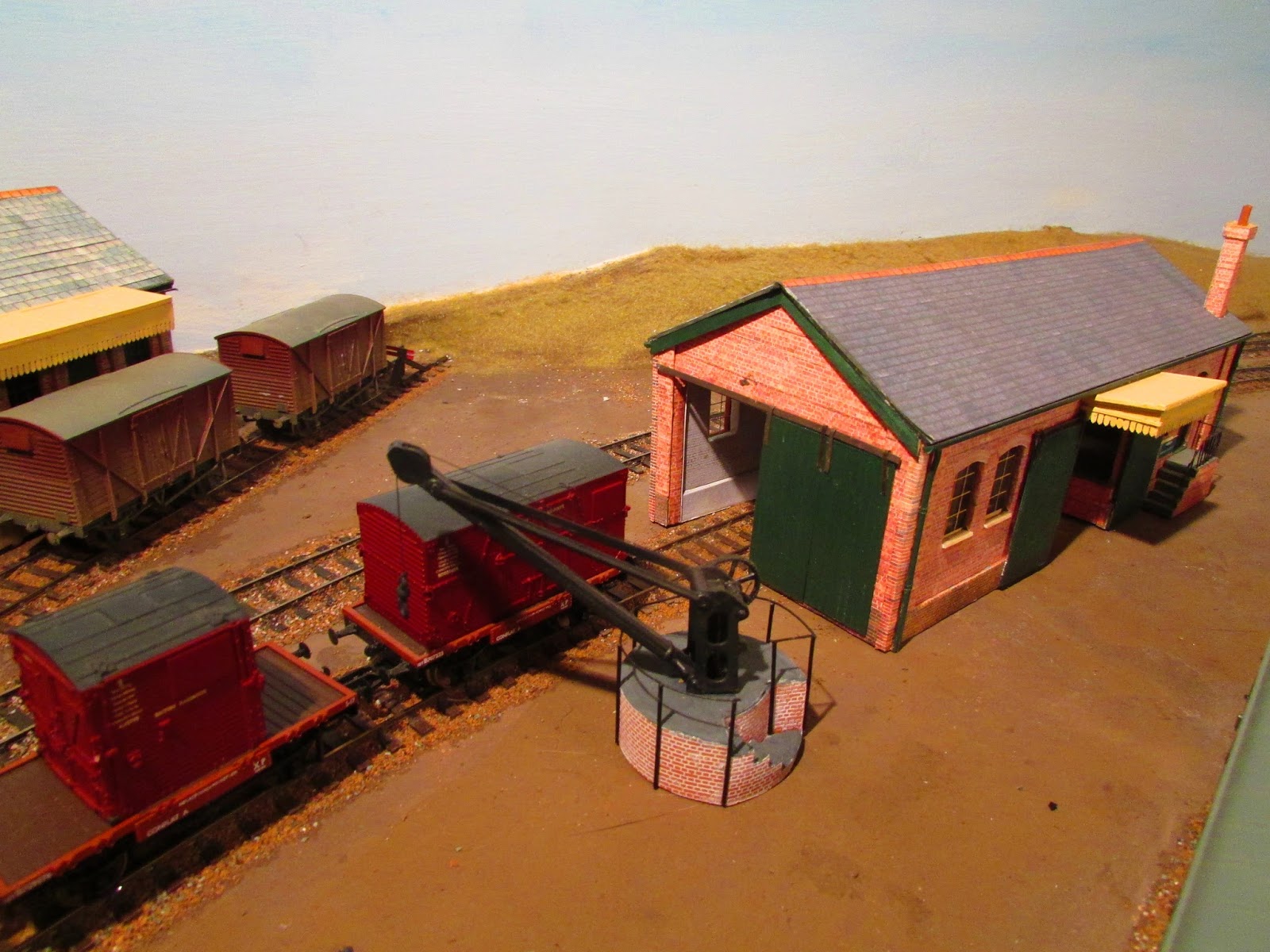

The yard now sports a crane (Wills) on a base inspired by one that used to be at Padstow, except that mine has a brick base.  Actually, the 'base' is the cut-down lid from an aerosol can.

The rather plain brown 'ground' definitely needs some scenic treatment. It will get it one day.

Water Tower


LSWR water towers were usually covered on top with corrugated iron sheets.  An exception was the one at Bude, which clearly lost it covering at some point.  Perhaps a Cornish gale blew it away and the company wouldn't risk replacing it.

I love quirky details like this, not least as I get the chance to model the water in the tank. My model is actually based on the tank that was at Axminster (which never lost its top), but without the original's rather splendid chimney. The coal stage is also inspired by the ones at Axminster and Bude.

I presume that the water pipe running up the side of the tower would have been installed when the station was connected to the mains water supply, after which the pumping engine would be redundant.

Coal Yard

 I'd intended to give this firm the name Taylor & Lowe, a Newquay merchant that actually had their own railway connection, but when modelling this scene I kept mistakenly referring to it as Giles & Powell. They used to deliver coal to my childhood home, and when I got married they delivered to mine too. So Giles & Powell it had to be.


Many model railways feature track-side coal staithes, which get filled directly from the wagons. I strongly suspected that this was a modellers' myth, having failed to find any photographic evidence for the practice. Consequently, coal from my wagons is mainly loaded into sacks, directly from the wagons, as is happening in this old photo, taken in Nantwich.

.

However, some coal – indeed, quite a lot of it – also found its way into staithes, and this photo seems to support the usual railway modellers' way of filling them. These staithes definitely back onto a siding and appear to have been filled, at least in part, from the railway side.

Messrs Giles & Powell have a few staithes, well-loaded with coal of various grades, but in line with my earlier 'myth' theory, they don't back onto the track. They are just visible on the right of my photo. For now I'm going to claim that they're filled in the same way as those in any other coal yard that didn't have a rail connection, though that would require a lot of shovelling to move the coal a short distance. More research is needed here.

Factory


This rather empty scene, taken across the approach tracks to St Petrock station, features the light engineering works of Tregonning & Hill. Their building started life as a pair of Model Railway Scenery.com North Light Factory walls. I turned them into a complete building by adding side walls and a roof.  I also gave it glazed windows, the originals being simply printed. If you look inside, you'll see what T&H produce — point motors!  Well I need somewhere to hide one and this seemed a good solution.

Garage


More memories from my 40 years in Newquay. Bill Julian and my dad were good friends, so dad often had his cars serviced by Bill. When my turn came, I bought a couple of cars from Bill and took them back there for the jobs I couldn't tackle.

Bill Julian's garage – first in The Whim and later on Henver Road – looked nothing like this one, but the  Scalescenes card kit does make up into a nice mode. Again, lots of work to do here to make the ground look right.

Level Crossing & Gas Works


The crossing keeper's house is another Scalescenes card kit – this time a cut-down model of their lock keeper's cottage. I've been working on the back garden today, hence the dark patches where the glue is still drying.

Beyond the level crossing, the gas works is beginning to take shape. Hopefully, I'll write more about that at a later date.

The photo also features the recently installed lineside fencing, courtesy of Slaters.  The 'wires' need to be painted grey, or whatever looks most like weathered wire.


Saturday, 19 December 2015

A canopy for St Petrock station

At long last Mr Walter Tregaskis, St Petrock's long-standing and long-suffering dental surgeon, may keep himself dry as he awaits the 6.24pm departure to Tregarrick North.

He could, of course, relax in St Petrock Station waiting room, but Cornish gales have a habit of blowing fumes from the old fire back down the chimney and patients of his, waiting for the same train, are wont to engage him in long conversation about their many ailments.  Better the fresh air.

Not that it rains that often in St Petrock - or so the local hoteliers and shop keepers will tell you. But even so, no self-respecting station should be devoid of a canopy, should it?  St Petrock folk aren't like the less privileged mortals of St Kew, Port Isaac, Otterham or Egloskerry; dear me no. There's is a proper station. 'Twaddn't till racent like... but 'tis now.

This particular canopy was knocked up in Plasticard, with etched brass valances from I know not where (Peedee Models do some nice ones), ornate ironwork on the pillars from GT Buildings (sadly soon to be discontinued) and a roll of corrugated copper strip that's been in my bitz box since time immemorial. It is based on the canopy that once graced Whitstone & Bridgerule station on the Bude line, having horizontal planking at the ends (see photo).  It's a little different to ones on the North Cornwall 'main' line, which have vertical planking and less ornate valances.  For me, such subtle variations are part of the fascination of railway modelling. If they send you to sleep, I apologise.


Tuesday, 29 September 2015

Turntable Tribulations

MetalSmith Ltd market a very nice range of turntables. Cheap, they are not (£117 for the 60ft kit, plus motor) but the quality is superb.  However, thinking I could save both money and time, I elected to buy a Peco LK-55 turntable.

I'm sure Peco have many, many happy customers, and it's not my intention to knock a perfectly respectable product, but I soon realized that, for me, it was probably the wrong decision.  Firstly, it's 300mm in diameter (equivalent to an unprototypical 75 feet) and secondly it's made of plastic. Okay — I knew all that before I bought it, 75 feet isn't that much bigger than Padstow's 70 footer, and plastic bearings surely shouldn't have been a problem... but read on.

I assembled the basic kit, then set about motorising it, using the recommended Meccano parts. I wanted the turntable to automatically stop when it aligned with the approach tracks, so invented my own solenoid 'lock', using parts of an old H&M point motor.  The photo shows the arrangement.  Amazingly (for me) it worked! Energising the H&M solenoid withdraws the plunger and also depresses the microswitch, which energises the turntable motor. When the next slot comes round, the plunger drops into it, thanks to the spring on the microswitch, which de-energises the motor.


Elated, I installed the completed turntable on St Petrock and set about laying the approach tracks.  Then disaster struck. The main bearing had been emitting some ominous noises, but a drop of oil seemed to cure the problem... until one day the whole lot jammed and sheared the plastic stem clean off the table base!

I toyed with consigning the broken remains to landfill, but couldn't bear the thought of writing off rather a lot of hard work, so I stripped the whole lot down and carefully substituted a metal bearing and spindle.


The bearing is the centre of an old Meccano cog wheel. Great care was taken in opening up the original hole to accommodate the new bearing. If it was off-centre, the whole thing would be ruined. 


This is the new spindle, mounted in another old Meccano cog middle, locked tight with the Meccano grub screw and fixed in place with epoxy resin. The tri-square ensures that it remains vertical as the 'poxy sets.   

Before reassembling, I also lined the turntable wall with brick-embossed Plasticard, to make it look more like the turntables at Padstow and Camden. This, in turn, meant that I had to trim the table length a bit to fit the now slightly smaller well.


(www.britainfromabove.org.uk)
The Peco model is clearly a scaled-up model of a smaller manually operated turntable.  All the 70 footers in my collection of photographs are vacuum operated, so the finishing touch was to extend the table deck and add the vacuum control apparatus.


The irony is that St Petrock didn't really need a 75ft turntable, or even a 70ft one. A 60 footer would have been adequate to turn a T9 or N.  Unbeknown to me, the Southern Railway obviously planned to run Bullied light pacifics into St Petrock, perhaps hauling the Atlantic Coast Express, so now I shall have to get one.  Is Father Christmas reading this?

Finally, just to prove that it really does work, here's a short video...


So... will I replace this turntable when time and finances permit?  Probably not. I'm actually rather pleased with the modifications I've made – particularly the brick lining and the vacuum apparatus – so here it stays.

Wednesday, 16 September 2015

Daddy's Shop

Here is my first home — mum and dad's shop in Argyle Street, Bognor Regis. That's little me in the pushchair, probably being propelled by my cousin Margaret.

Within a couple of years, mum and dad had sold up and moved to Newquay, and a further 52 years were destined to pass before I returned to Bognor Regis.  By then, the shop had become an Indian Restaurant, and very good it was too.  When I showed them this photo and told them the story, they gave me a free aperitif with my meal.  Lovely folk!

It didn't take me long to decide that St Petrock must include a model of dad's shop, with his name proudly displayed over the front door. I've changed the proportions of the building slightly, to fit the available space but, despite my questionable modelling skills, it is, I hope, easily recognisable. To dispel any lingering ignorance when folk visit the layout, a print of the original photo hangs on the wall above it.

I will eventually get round to bedding down the building properly, to get rid of that 'orrible black line at pavement level. One of next door's chimneys needs attention too, I see. It, by the way, together with the rest of its building, belongs to that august firm of St Petrock solicitors, Messrs Swindle & Cheatem. Personally, I prefer to spend my time in the Cornish Arms, across the road. With beer at one shilling a pint, who wouldn't?

Thursday, 22 January 2015

The Fiddle Yard

Prior to building St Petrock, most of my railway layout plans had been centred on through stations, with a fan of partially hidden sidings for off-scene storage of trains. This configuration had the dubious advantage that trains could be round round-and-round the room, though such operation is hardly prototypical.  The only examples I can think of are the 'merry-go-round' coal trains supplying power stations, and London's circle line.

Operationally, a terminus-to-fiddle yard configuration has a lot more potential than a simple through station. "The great thing about a terminus," as the ticket inspector told the old lady, "is that everything stops... or else there's a very big bang."

Early posts on this blog have described the terminus end, as it takes shape. Until this week, though, the track from St Petrock ended beneath a road bridge on the estuary section.  I had toyed with building a cross between a Peter Denny-style rotating storage unit a sliding traverser, but in the end decided to keep things simple and have storage cassettes.  These have been well described in the model railway press and mine are nothing special... but they do work.  A train arriving from St Petrock runs onto a cassette, which is then unplugged from the approach track, rotated by hand, then either set aside so that another cassette can be inserted, or reconnected for the return journey. Simple!

Now, for the first time since commencing St Petrock, I can run trains properly and thoughts are turning to developing a timetable.  However, there's still an enormous amount of modelling to undertake, so for my next post I'll return to the houses on Station Road.


Thursday, 6 November 2014

Dead Meat

Halwill Slaughter House
Railway modellers often add industrial buildings to their layouts, in order to justify some extra freight traffic.  I've seen oil depots, gas works, cattle feed merchants, china clay linhays, milk factories and a paper mill, but never a slaughter house.  Perhaps the subject is too grusome for your average modeller, though I somehow doubt that our ranks include more vegetarians than the rest of society.

With their keen eye for business, the London & South Western Railway built slaughter houses at Halwill, Holsworthy and Bude stations, and I was determined that St Petrock should have one too. As well as the obvious traffic in dead meat for Smithfield, they used to generate traffic in sheepskins, wool and animal fat (for candles), though I don't know how much of this 'extra' traffic survivied into the late 1950's.


I built my model using my favourite method – card, faced with Scalescenes brick paper.   I experimented with printing the window frames on inkjet-friendly acetate, but it didn't really work.  Cream coloured printing came out far too faint, so I reluctantly settled for dark brown.  That'll do for now, but I'll eventually replace them with etched frames from GT Buildings.  That's when I'll also add some drain pipes... and handles on the doors might be useful too!


Wednesday, 9 July 2014

Progress at St Petrock Station


Please be assured, dear reader that, during my long absence from this blog, my modelling activities have not entirely ceased.  Progress has, however, been moderated by other priorities, such as decorating the lounge, refurbishing the bathroom and erecting a new fence in the garden.  I wouldn't wish you to think that I've been idle!

Anyway, despite all this, there has been some progress at St Petrock Station, though, as you'll see from the photos, there's still much to do.

The main platform is almost complete, and is edged with Southern Railway 'harps & slabs" (from Peco), in-filled with Polyfilla and painted to look like tarmac. I now realize that the edging should have had at least one extra row of paving slaps behind it, but I don't feel inclined to correct this omission. Perhaps the contractor didn't know what he was doing.  Yes, that's a good excuse.

The running-in board is a Dart Casting with lettering on plain paper, printed using my computer. In the background you can see the goods shed beginning to take shape.

If you look at earlier photos of the station building, you'll see that the platform there has brick edging and a paved surface, giving the impression that the platform had been extended (doubtless in the 1930s) to cope with the growing holiday traffic.

The following photos show the station and station yard.  Station Master Hubert Penrose's greenhouse has appeared, but vegetables have yet to grow in his garden.  Thankfully, when they do, the Southern Railway are in the process of giving him a stout fence, so passengers with nothing better to do won't be pinching his beans.
The last photo shows the harbour branch passing behind the station yard and descending at about 1:36, beneath Station Road.  The pots of green and yellow poster paint in the background are not part of the intended scene!  A model of my dad's old shop is planned for that spot.