Labels

Showing posts with label St Petrock. Show all posts

Sunday, 7 February 2021

Tolcarne Junction

This is (or rather was) a seldom-photographed corner of my layout.  Scenery was rudimentary as it simply existed to bring the St Petrock branch line around my desk at the end of the railway room. Bourdon Mill is on the right and the rotating storage sidings in the foreground. 

Trains from St Petrock station are imagined to take three different routes.  Most go up the North Cornwall 'main' line to Halwill Junction and Okehampton, whilst the branch trains go either to Tregarrick North (Southern region) or Tregarrick General (Western region).  In truth, they all followed the same line into the storage sidings. But not any more... 


Trains for Tregarrick North now diverge at Tolcarne Junction.  The only service on this line is this Auto Train, which doesn't need to be turned before returning to St Petock, so a simple storage line on the other side of the backscene suffices.


Tolcarne Junction only has three signals.  The rest are 'off scene', but even if the junction was fully signalled, the signal box would only need 9 or 10 levers. The signal box is consequently rather too large for the job, but its a beautiful model that I found hard to resist buying.  I justify its existence by postulating that the junction was once more complex, with a passing loop on the 'main' line, but that the layout was simplified in the 1930s. 

The photos above show the Peco Smartswitch control board and its associated bank of switches. Together they control the three signals at Tolcarne Junction and the turnout.  On the left is an auto/manual switch that, in the 'auto' position, transfers control to the Automatic Crispin (Raspberry Pi computer).  

I was determined that Tolcarne Junction would operate automatically. When I run the railway, I am the signalman at St Petrock; I can't be the signalman up the line as well, or I would be sending trains to myself!


The 'Train Detect' button at Tolcarne Junction duplicates the action of a Block Signalling BOD-2 RLY infra-red train detector. I suppose I could have made one myself, but this little fellow does the job faultlessly, is very neat and cost £17.  It tells the Automatic Crispin, after a suitable time delay, to ring either 2-1 (train out of section) for an up train, or 2 (train entering section) for a down train. 


This bank of relays is controlled by the Raspberry Pi.  Four of the relay outputs duplicate the Tolcarne Junction signal and turnout switches, and a fifth switches power to the rotating storage sidings.


Finally, just to assure my loyal reader that Tolcarne Junction really does connect with something, here's a photo of the rest of the railway, with the lid removed from the storage sidings. 


Wednesday, 23 October 2019

St Petrock goes AC

Once upon a long time ago I was privileged to be a regular operator on Peter Denny's famous Buckingham model railway. My station for the best part of 37 years was Grandborough Junction, where one of my important jobs was to communicate with the signal box up the line at Quainton Road... except that there wasn't a Quainton Road on the model.  To simulate this station, Peter built an amazing electro-mechanical computer that ran the timetable, controlled the clock, set points in the storage sidings and communicated with the 'up' block instrument at Grandborough.

Hitherto, the 'Quainton Road' storage sidings had been operated by Peter's youngest son Crispin, but sons don't stay at home for ever. The computer that replaced him was therefore known as the Automatic Crispin. Peter wrote an article about it for the Railway Modeller and I well remember the title  - "Buckingham Goes AC".

It will therefore come as little surprise to friends and followers of the St Petrock saga that my station should also have a computer to simulate the signal box up the line. However, time and technology move on, so rather than building it from plywood and Meccano, I've used a Raspberry Pi single-board computer. In honour of its illustrious ancestry, though, it too is known as the Automatic Crispin.

Mine has a slightly simpler job to do as I don't have points on my storage sidings, but I did want it to display operational notes and the timetable for the St Petrock operator.

My first task was to learn how to instruct the Raspberry Pi to perform to my wishes, so I spent several weeks teaching myself Python, then writing a program.  Fortunately, Python has some similar features to the Control Basic language that I used to use at my work, so the task wasn't too daunting.  I also discovered that program code for many of the routines was available on the Internet.

Here's a little bit of the code that checks the St Petrock bell button and trip rail near the storage sidings, and displays the 'hours' value. It would probably turn expert programmers to drink, but it works and I'm actually rather proud of it.

def get_button_push(after_push_time):
    GPIO.output(12, GPIO.HIGH)
    while True:
        if (GPIO.input(20) == GPIO.HIGH):
            time.sleep(0.1)
        else:
            GPIO.output(12, GPIO.LOW)
            time.sleep(after_push_time)
            return()

def get_storage_exit():
    while True:
        if (GPIO.input(16) == GPIO.HIGH):
            time.sleep(0.1)
        else:
            time.sleep(2)
            return()


def display_clock(hour,clockhr,minute):
    if (minute == 0):
        rect = Rectangle(Point(377,10), Point(417,50))
        rect.setFill('black')
        rect.draw(win)

    if (clockhr)>9:
        txt = Text(Point(397,30),clockhr)
    else:
        txt = Text(Point(407,30),clockhr)

       
    txt.setTextColor('white')
    txt.setSize(30)
    txt.draw(win)


The screen is an Elecrow 5 inch LCD display that plugs directly into the Raspberry Pi and sits on top of it. Here's a close-up.  You'll see that the operator has a couple of instructions to carry out before train working No.2 can depart for Tregarrick North at 6.40am.


Now the M7 has been attached to its auto coaches and waits at platform 2. A light beneath the bell-push reminds the operator that the clock has stopped  – trains at St Petrock never run late! After checking that the rotating storage sidings are set to road 5, the operator presses the bell once (call attention). The signalman at Tolcarne Junction responds with one beat on the bell.


The St Petrock signalman (or frequently signalwoman) sets the points, then pulls off signals 15 (platform starter) and 12 (advanced starter). The Gas Street crossing keeper also obediently opens the gates.


St Petrock now rings '3 pause 1' – 'Is line clear for a stopping passenger train?' Tolcarne Junction responds by ringing 3-1 and turning the block instrument to 'LINE CLEAR' (green).


The M7 sets off with its train, past the signal box. (Note to self: "That box needs a name board and some levers!")

As the train passes the signal box, the signalman observes that it has a tail lamp (and therefore hasn't left its tail behind) and rings 2 bells (ding...ding... train entering section). Tolcarne Juntion acknowledges with 2 bells and turns the block instrument to 'TRAIN ON LINE' (red).


As the train enters the storage sidings it crosses this trip point (two breaks in the nearside rail) that momentarily energise a relay, instructing the Automatic Crispin to ring '2 pause 1' (train out of section).


St Petrock acknowleges with 2-1, which restarts the clock. The Gas Street crossing gates close once more and the sequence is complete.


Tuesday, 9 April 2019

Gas Street Level Crossing

I was determined to have an operational level crossing on my railway. As it's turned out, the crossing gates control a very minor road indeed, just the access to St Petrock gas works, but they do add operational interest and keep visitors enthralled. Crossing keeper Fred Cockram and his long-suffering wife are kept fully occupied and the couple have been rewarded with a nice house to live in.

It's recently dawned on me that Fred ought also to have a little shed by his crossing, from which to communicate with the signal man at St Petrock, so this will be added before too long.

The crossing gates are from Peco and they're operated by a pair of Peco Smartswitch servos. The challenge, of course, was to get the gates to open and close in sequence and this was achieved with a couple of micro-switches, activated by the servo arms.

In this photo the bottom left micro-switch is being held closed, so when the crossing is activated the right hand servo will move first. When it has completed its travel, it will close the top micro-switch and activate the other servo. The amount by which the servos move, and their speed, is controlled by the Smartswitch control module (on the right).


Here is a video of the crossing in operation...


Sunday, 7 April 2019

Gas Works


Gas works were a common sight until the advent of gas supplies from the North Sea around 1970 and they usually had rail connexions for the delivery of coal and removal of coke.

St Petrock station draws much of its inspiration from Bude, which had a large, relatively modern gas works. However, I preferred the somewhat ramshackle appearance of earlier designs, many of which survived until the end of the town gas era.

One such survival was Truro's and Peter Denny used it as a basis for his model at Buckingham, which I had the great privilege of seeing on many occasions. The large building on my model is, in turn, based on his.

Coal is delivered by rail at A and taken into the retort house B on a side-tipping wagon. Heat from the boiler house K carbonises the coal and the resultant gas is fed through the exhauster house C to the condenser D, where the gas is cooled. Large particulates suspended in the gas are removed in the scrubber F, then ammonia is removed in the washer G. The final stage of refining is the purifier H - three tanks, containing iron oxide. Passing the gas though these removes sulphur – the culprit for the rotten egg smell that always seemed to pervade these old gas works. Finally, the now fully refined gas passes through the meter house I, to be stored in the gas holder J.

After gas is removed from the coal it becomes coke. This is removed from the retort house on a second side-tipping wagon and deposited at L for resale. One might expect this to be removed by rail, but at St Petrock the coal yard of Messrs Giles and Powell is nearby, and it all goes there (or rather, it will do when I provide them with a suitable lorry). E is a tank that collects tar from the retort house, condenser and scrubber. M, sited at the works entrance, is the office.


The wagon is standing on dual-gauge track at the coal delivery point. The narrow-gauge side-tipper at the back would be hand-pushed into the retort house. Coke comes out of the retort house on the line nearest the camera.

For details about the next three items I am indebted to Countryside Models for photos of their exquisite model gas works – far nicer than mine. 


The tall structure behind the tar tank is the condenser.  Quoting from Countryside Models...
    "The condenser itself is a piece of equipment which helps date the model.  So far modellers have reproduced either early air-cooled serpentine condensers or the Victorian tubular "Annular Condensers" but these were replaced from the 1930s onwards by more efficient condensers in which electricity was used to pump water through the gas in tubes (like a loco boiler in reverse)."
I really must do something about the empty space behind the condenser and the rather obvious join in the backscene.  My gasworks doesn't yet have a workshop for the maintenance fitters, so this is where it will go.


The scrubber and washer, with the tar tank to the right. I presume that the building beneath the tank contained some means of keeping the tar warm and liquid.

The oxide tanks.  Poo.. what a smell!


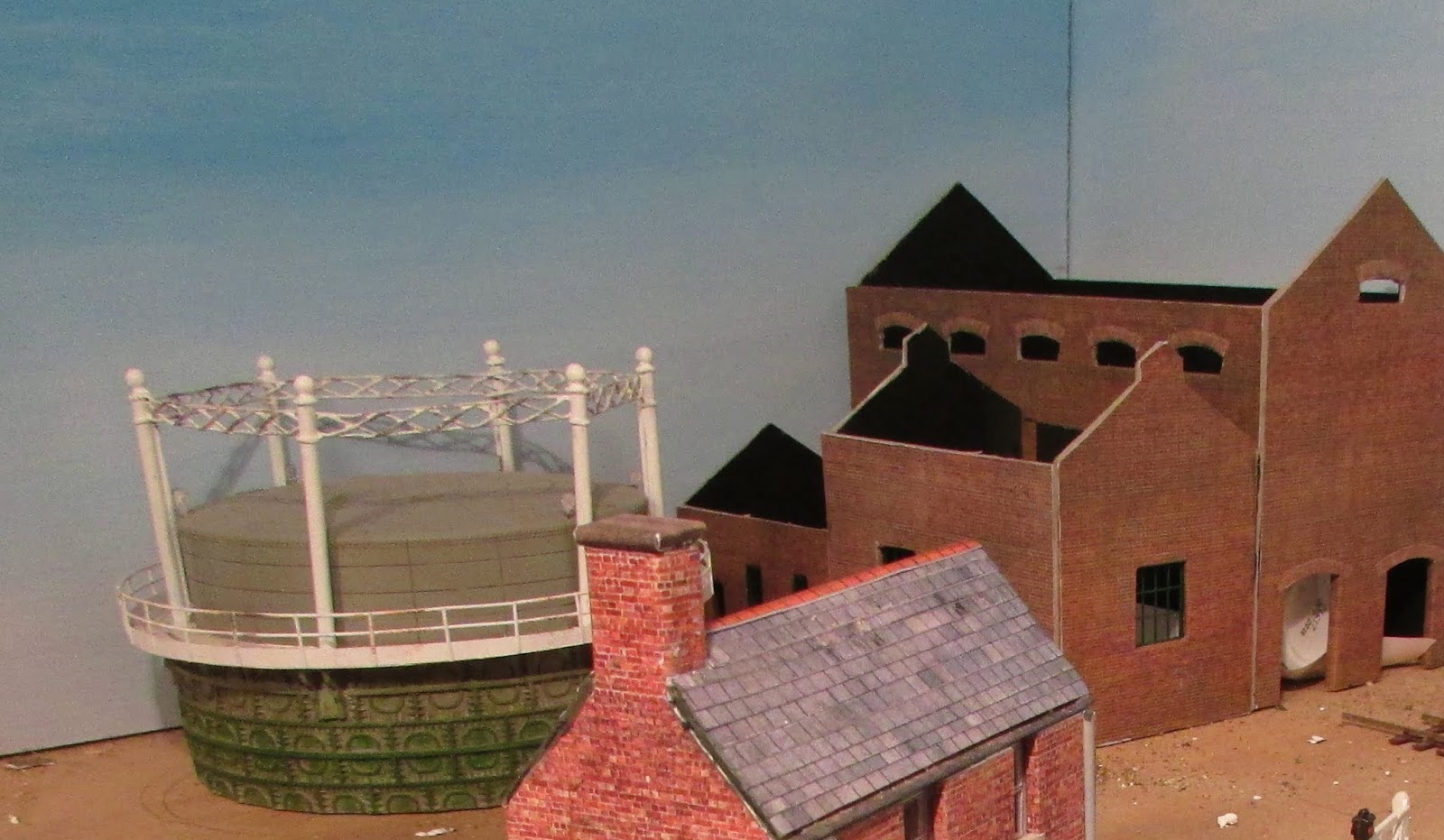
The gas holder started life as a Hornby Scaledale model. I believe it was based on one at Fakenham but, to my mind, was much too small.  I therefore sliced it in half, added a tall centre section and built my own steelwork around it, using Evergreen styrene mouldings.

The photo on the right shows the gas works early in its construction, with the unmodified Hornby gas holder. I hope you'll agree that mine is an improvement.


Wednesday, 3 April 2019

Trackwork is complete

Last week I laid the final piece of trackwork. There may well be minor changes in the future but the basic track plan is now complete. This is how it was originally conceived, back in November 2013...


… and this is how it's turned out in April 2019.


The most obvious change is the new revolving fiddle yard. The original one proved unworkable – just try imagining yourself attempting to turn around a 3ft 6in long cassette, loaded with a loco and four coaches, then lifting it over several other cassettes, and you'll get the idea! By comparison, the new arrangement has been a great success and is a joy to operate.

Under construction. The original, torturous fiddle yard was on the right

Operational. The little sliding bolt aligns the tracks and completes the electrical circuit.
The baseboard that once held the cassette fiddle yard is now home to Bourdon Halt, which is based on Dunmere Halt on the former line to Bodmin North. I had always associated 'pagoda' waiting shelters with the GWR but here's proof that the LSWR had them too.

Dunmere Halt (photo: HC Casserley)


But why "Bourdon Halt"?  Well, several years ago the old pipe organ in St Illogan Parish Church was being demolished and I pocketed one of the organ stops. It was the odd one out as it was a dummy - Illogan's organ never had a 16ft Bourdon pipe. I therefore resolved that its later years would be more useful than its former ones and used it to control the turnout to Bourdon Mill.


And here is Bourdon Mill, the premises of Josiah Penrose & Sons, seed merchants and suppliers of agricultural miscellanea. Since there is no run-round at Bourdon Mill, the siding is only serviced by the morning goods train from Tregarrick North to St Petrock. Anything destined for further afield has to reverse at St Petrock and leave by one of the 'up' goods trains. 

These photos emphasises all too clearly that, though the St Petrock trackwork is complete, there remains much to do on the scenic side. St Petrock is far from being finished... perish the thought!


Tuesday, 20 December 2016

One year later... an update

I really should have posted something here before now. I wouldn't wish my loyal followers (all two of them) to think I've been inactive, but I keep telling myself "I'll write something about that when it's finished." The problem is that nothing on St Petrock is finished. Instead, I've been gradually 'working up' the detail on the whole layout, concentrating my effort in different places with little appeal to logic.  The advantage of this approach, I tell myself, is that I don't risk getting bored – one day buildings, another day rolling stock, and another scenery....

So here's an update on a year at St Petrock.

Station Buildings Area


Not much has changed here, the most important thing being that all track is now ballasted, using Woodlands Scenics fine brown ballast. I mixed in some grey chippings to make it look like the ballast that used to come from Meldon Quarry, but may have overdone it a bit.  Oh well... too late to change it now.

Goods Yard


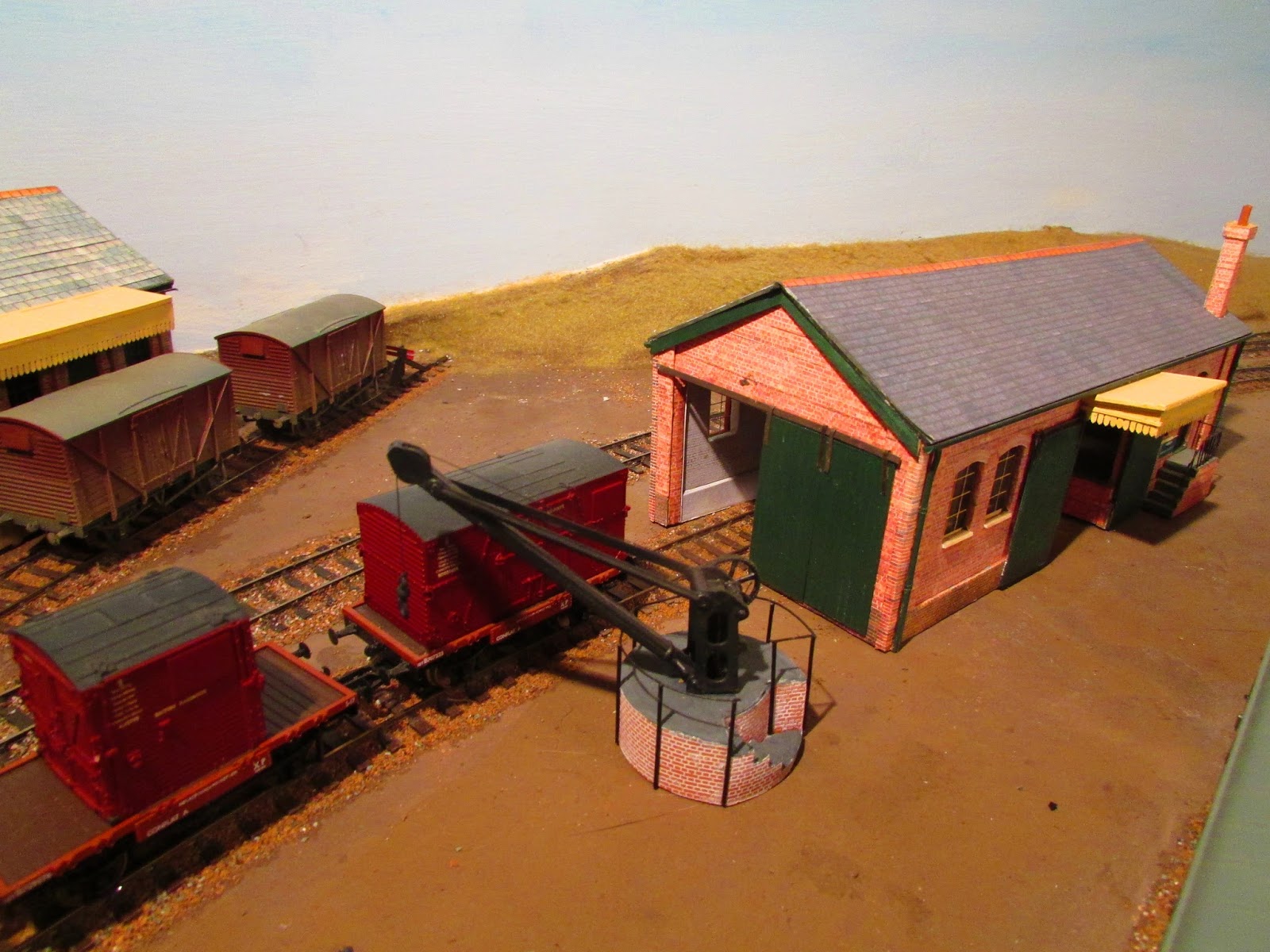
The yard now sports a crane (Wills) on a base inspired by one that used to be at Padstow, except that mine has a brick base.  Actually, the 'base' is the cut-down lid from an aerosol can.

The rather plain brown 'ground' definitely needs some scenic treatment. It will get it one day.

Water Tower


LSWR water towers were usually covered on top with corrugated iron sheets.  An exception was the one at Bude, which clearly lost it covering at some point.  Perhaps a Cornish gale blew it away and the company wouldn't risk replacing it.

I love quirky details like this, not least as I get the chance to model the water in the tank. My model is actually based on the tank that was at Axminster (which never lost its top), but without the original's rather splendid chimney. The coal stage is also inspired by the ones at Axminster and Bude.

I presume that the water pipe running up the side of the tower would have been installed when the station was connected to the mains water supply, after which the pumping engine would be redundant.

Coal Yard

 I'd intended to give this firm the name Taylor & Lowe, a Newquay merchant that actually had their own railway connection, but when modelling this scene I kept mistakenly referring to it as Giles & Powell. They used to deliver coal to my childhood home, and when I got married they delivered to mine too. So Giles & Powell it had to be.


Many model railways feature track-side coal staithes, which get filled directly from the wagons. I strongly suspected that this was a modellers' myth, having failed to find any photographic evidence for the practice. Consequently, coal from my wagons is mainly loaded into sacks, directly from the wagons, as is happening in this old photo, taken in Nantwich.

.

However, some coal – indeed, quite a lot of it – also found its way into staithes, and this photo seems to support the usual railway modellers' way of filling them. These staithes definitely back onto a siding and appear to have been filled, at least in part, from the railway side.

Messrs Giles & Powell have a few staithes, well-loaded with coal of various grades, but in line with my earlier 'myth' theory, they don't back onto the track. They are just visible on the right of my photo. For now I'm going to claim that they're filled in the same way as those in any other coal yard that didn't have a rail connection, though that would require a lot of shovelling to move the coal a short distance. More research is needed here.

Factory


This rather empty scene, taken across the approach tracks to St Petrock station, features the light engineering works of Tregonning & Hill. Their building started life as a pair of Model Railway Scenery.com North Light Factory walls. I turned them into a complete building by adding side walls and a roof.  I also gave it glazed windows, the originals being simply printed. If you look inside, you'll see what T&H produce — point motors!  Well I need somewhere to hide one and this seemed a good solution.

Garage


More memories from my 40 years in Newquay. Bill Julian and my dad were good friends, so dad often had his cars serviced by Bill. When my turn came, I bought a couple of cars from Bill and took them back there for the jobs I couldn't tackle.

Bill Julian's garage – first in The Whim and later on Henver Road – looked nothing like this one, but the  Scalescenes card kit does make up into a nice mode. Again, lots of work to do here to make the ground look right.

Level Crossing & Gas Works


The crossing keeper's house is another Scalescenes card kit – this time a cut-down model of their lock keeper's cottage. I've been working on the back garden today, hence the dark patches where the glue is still drying.

Beyond the level crossing, the gas works is beginning to take shape. Hopefully, I'll write more about that at a later date.

The photo also features the recently installed lineside fencing, courtesy of Slaters.  The 'wires' need to be painted grey, or whatever looks most like weathered wire.